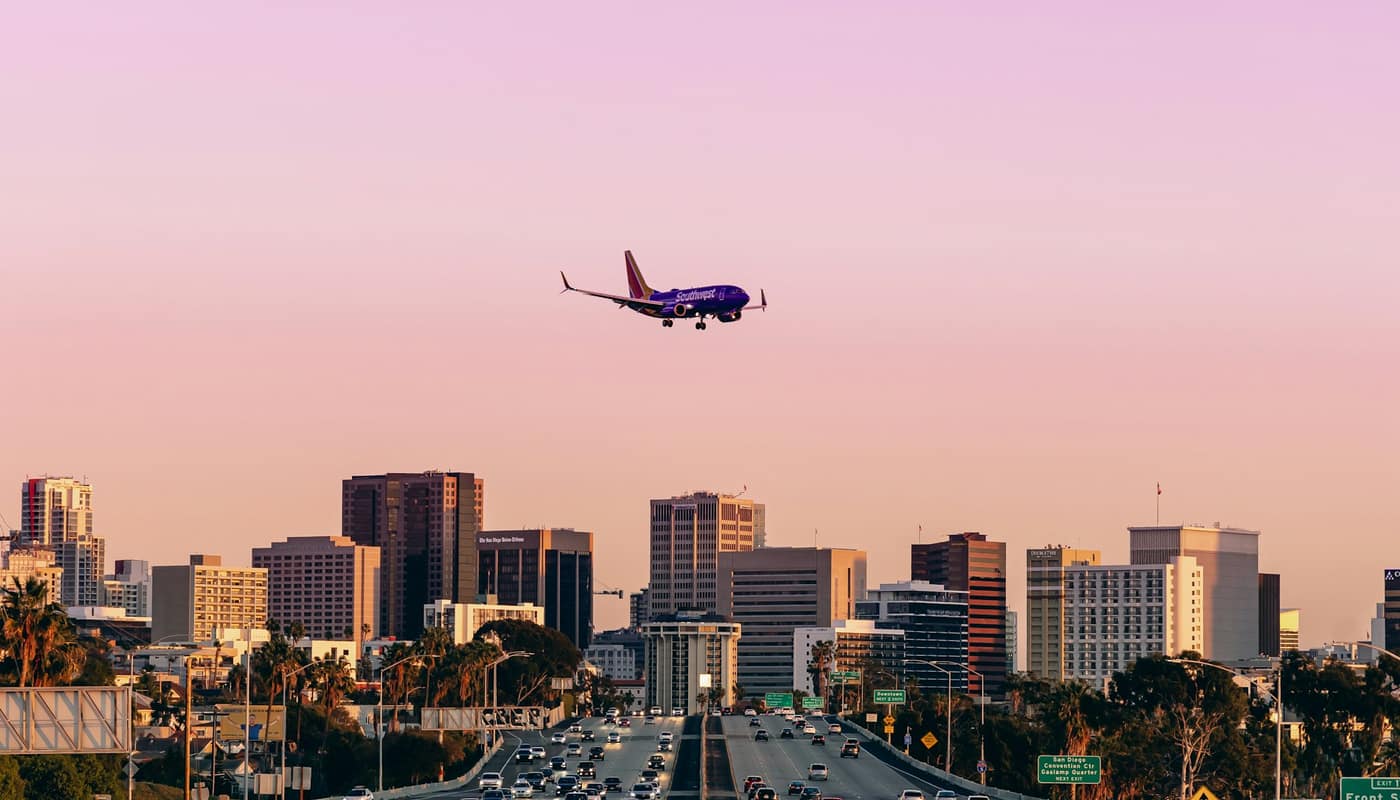
San Diego International Airport sits on a sliver of land beside downtown and the bay, a few minutes from the heart of the city. That location is the airport’s greatest convenience and its greatest constraint. It is also the reason the airport is often described as the busiest single-runway commercial airport in the United States, and the reason so many decisions about it are matters of public debate.
Who actually runs the airport?
The airport is not operated by the City of San Diego. It is run by the San Diego County Regional Airport Authority, an independent public agency created by the California Legislature in the early 2000s to take over operation of what was then called Lindbergh Field. The authority also has responsibility for regional airport planning, and it took on a second job as the county’s Airport Land Use Commission, which reviews development near airports around the county to protect both residents and flight paths.
A board of directors made up of members appointed by local elected officials governs the authority, with additional non-voting members representing the military and other interests. The board hires a chief executive and a staff. Meetings are open, with agendas and minutes posted publicly. The airport’s name changed from Lindbergh Field to San Diego International Airport around the time the authority took charge, though many locals still use the old name.
How does the airport pay its bills?
Airports of this type are generally expected to support themselves rather than rely on city general funds. San Diego’s airport earns money from airline rents and landing fees, concessions such as restaurants and shops, rental cars, parking, and a passenger facility charge added to tickets, which is a federally authorized fee that funds airport improvements. It also receives federal grants for certain projects and issues revenue bonds that are repaid from airport income.
That setup has a practical meaning for travelers and residents. A fee on a ticket and a parking charge at the terminal are the airport’s own revenue streams. Neither one is a tax collected by the city, and the authority’s board, not the city council, decides how to spend the money.
Why only one runway?
The airport occupies a little over 600 acres, bounded by San Diego Bay, Interstate 5 and neighborhoods, and the Navy’s property nearby. There is no room to add a second runway. The single runway, roughly 9,400 feet long, handles both departures and arrivals, which limits how many flights can use the airport each hour.
Over the years, regional leaders have studied and debated whether a second major airport or a new site for the existing one would serve the region better. Proposals to move the airport to a military site were rejected by voters in 2006, and the authority has since focused on making the current site work as well as possible. That strategy shapes everything from terminal design to the routes that airlines choose to fly from San Diego, which tend to favor larger planes on busy routes.
What is the overnight curfew?
Because the airport sits so close to homes, the authority enforces a departure curfew overnight. Commercial aircraft are generally not supposed to take off between roughly 11:30 p.m. and 6:30 a.m., although arrivals are permitted at any hour. The curfew is one of the better-known features of flying out of San Diego, and the authority tracks and reports departures that violate it.
The curfew explains why the last flights of the evening are often delayed back to the gate rather than allowed to leave late, and it is part of the reason that airlines schedule heavily around the morning hours.
What are the terminals like?
The airport has two terminals. Terminal 2 is the larger one, divided into an east and a west side. Its west side was greatly expanded in the “Green Build” program, a project that earned the highest level of green-building certification from the U.S. Green Building Council and added gates and a dedicated area for international flights.
Terminal 1, the older and smaller of the two, is being replaced. The authority has been building a new Terminal 1 in phases. Its first phase opened in September 2025, replacing a building that was more than half a century old, with additional gates scheduled to open as construction continues and a final set of gates expected in the following years. Phase 1B is being built on the site of the old terminal and is meant to complete the new building. Reported budgets for the overall project have varied across sources and press releases, because they measure different things, so anyone interested in costs should look at the authority’s own board documents.
The airport also has a rental car center away from the terminals, with shuttles, and a roadway system that has changed as the new terminal takes shape.
How does the authority deal with noise and neighbors?
The flight paths that make the airport so convenient also put aircraft over homes, schools and parks close to the shoreline. The authority runs a noise-mitigation program that includes sound insulation for eligible homes and schools near the airport, and it publishes noise reports and takes complaints from residents. The overnight departure curfew is the most visible piece of that effort, but not the only one. Flight procedures, runway use and aircraft types all affect what neighbors hear, and the authority works with the Federal Aviation Administration, which controls the airspace, since the authority itself does not direct aircraft in the air.
How do travelers get there without a car?
The airport’s location makes transit practical. MTS Route 992 runs between the airport and downtown on a frequent schedule through most of the day and into the evening, and MTS also lists a free shuttle link between the airport and the Old Town Transit Center, where the Trolley, COASTER and Amtrak stop. Details of the Trolley network appear in riding the Trolley and buses. Service hours and stop locations have moved during construction of the new terminal, so check the current MTS schedule before relying on a late-night or early-morning bus.
Rideshare and taxi pickup areas are also set up in designated zones, and these change as construction progresses.
How does the airport connect to the rest of the region?
The airport’s neighbor on the bayfront is the Port of San Diego, which manages the tidelands and runs the Harbor Police department that serves the airport as well as the bay, a relationship described in what the Port of San Diego manages. The airport is also a large employer, tied closely to the region’s tourism and business travel, and to the visitor spending that supports much of the local economy, as explored in the regional economy.
Many travelers heading to or from Mexico use the region’s land crossings rather than the airport, a different system with its own agencies and rules, covered in how the San Ysidro border crossing works.
What to remember
San Diego’s airport is small in area, constrained by its site, and governed by a dedicated authority that answers to local appointing officials rather than to a city council. The single runway and the overnight curfew shape how it operates. A major rebuild is replacing the oldest terminal, and travelers can expect changes to roads, bus stops and gate assignments while construction continues.
Sources: San Diego County Regional Airport Authority; San Diego Metropolitan Transit System; Federal Aviation Administration; U.S. Green Building Council